





Condition: Used · Stock: 1
Testing, included items, and known limitations are documented below. Questions before purchase? Contact a technician.
7-day return policy · Freight and shipping details are confirmed for the specific item before dispatch.

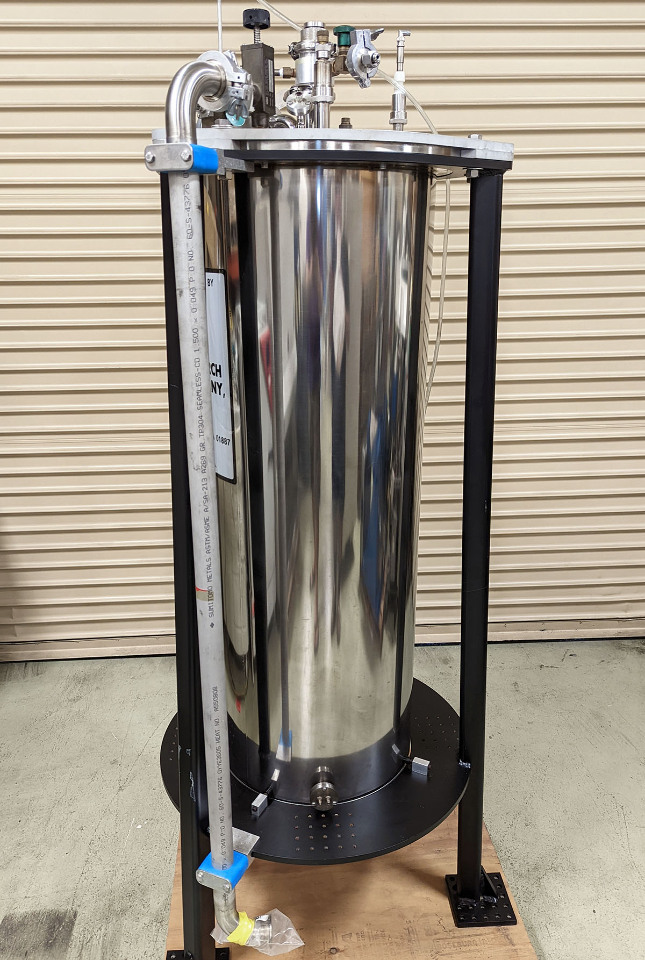
Clean and in excellent physical condition as shown in the photographs. While we did not have the necessary equipment to test this in our facility, it was removed from a working system in a high profile DOE laboratory with a track record of regular maintenance. The most recent notes on the unit stated that it was functioning as of Mar 2022 but was then stored after a complete system upgrade.
We believe the unit to be complete but please check the pictures carefully. Everything (aside from the pallet jack) in the photos is included but nothing more.
Due to the size and weight of the unit, it will need to be shipped via freight carrier. If you have your own logistics partner, we will palletize and prepare it for pickup. If not, contact us for a quote. Local pickup is always welcome.
Technical Reference & Synthesis
Janis Research SuperVariTemp (SVT) Cryostat | Model 16-CNDT-SVT
Note to Researchers: Direct digital manuals for legacy Janis hardware are famously scarce. The following technical profile has been synthesized by SocoTek through cross-referencing archival data from Lake Shore Cryotronics, Caltech, and Argonne National Laboratory repositories to ensure accurate operational parameters for this unit.
1. Model Architecture
The 16-CNDT-SVT designation identifies a dual-reservoir, high-efficiency cooling system:
- 16: Refers to the dewar diameter/capacity (approx. 16L total volume).
- CNDT (Center Nitrogen, Dual Tank): Features an inner Liquid Helium (LHe) reservoir protected by a Liquid Nitrogen (LN2) radiation shield and vacuum jacket.
- SVT (SuperVariTemp): Utilizes the "Sample-in-flowing-vapor" method for superior thermal response times compared to standard exchange-gas units.
2. Operational Logic & Performance
The SVT system is designed for high-throughput research where rapid sample cycling is critical.
- Flow Principle: Cooling is achieved by pulling cryogen through a capillary and vaporizing it directly over the sample and holder.
- Sub-4.2 K Performance: Temperatures as low as 1.5 K are achievable by throttling the needle valve and evacuating the sample space, without the need to pump on the main LHe reservoir.
- Temperature Range: Standard 1.5 K to 300 K (Extended to 325 K via internal heater).
- Efficiency: Typical cooldown to 5 K in ~30 minutes; static LHe consumption adds only ~0.1 L/hr to base evaporation.
3. Critical Maintenance & Safety
- Vacuum Integrity: Insulating vacuum must be maintained at 10⁻⁴ Torr or lower prior to cryogen introduction.
- Moisture Management: To prevent capillary blockages, it is recommended to invert the cryostat during warm-up once safe temperatures are reached if the sample stick is removed.
- Thermal Guard: For operation above 325 K, continuous evacuation of the vacuum space is required to mitigate heater outgassing.
- Pressure Relief: Ensure a gravity-activated or mechanical relief valve is installed on the inner reservoir at all times.
- • Lake Shore Cryotronics (Janis Legacy Documentation)
- • Argonne National Laboratory (APS Division Lab Archives)
- • California Institute of Technology (Low Temperature Physics Repository)
- • SocoTek Internal Technical Assessment
